Written as you push
Every push to an open pull request, Flash drafts a description for any public symbol that's still missing one, batched per changed file, so docs never fall behind the code.
Evidence-driven code intelligence
Aletheore reviews, audits, and monitors repositories with every finding traced back to source evidence: file, line, symbol, owner, commit, dependency, and risk.
Source-availableLocal-first CLIHosted GitHub App
Every alert, review, audit, and query resolves back to:filelinesymbolownercommitdependencyrisk
How resolution works
Every alert Aletheore raises is a resolved path, not a guess. This one is real: it was read from a scan of Aletheore's own repository.
A route the scanner found in github-app/app_server/admin.py.
The scanner resolved the route to github-app/app_server/admin.py at line 540.
admin_page spans lines 541 to 601 of github-app/app_server/admin.py.
49 commits touch this file, 100% of them by this author.
2026-09-25: restructure: Overview page and dashboard shell to match the approved mockup
49 commits and 3 dependent modules put this file on the hotspot list.
What it covers
Run locally with the CLI, install as a GitHub App, or give coding agents a smaller evidence context through MCP.
Automatic PR comments and Flash reviews on every push, plus managed audits and branch-protection checks that cite the changed file and line.
AIRview, live
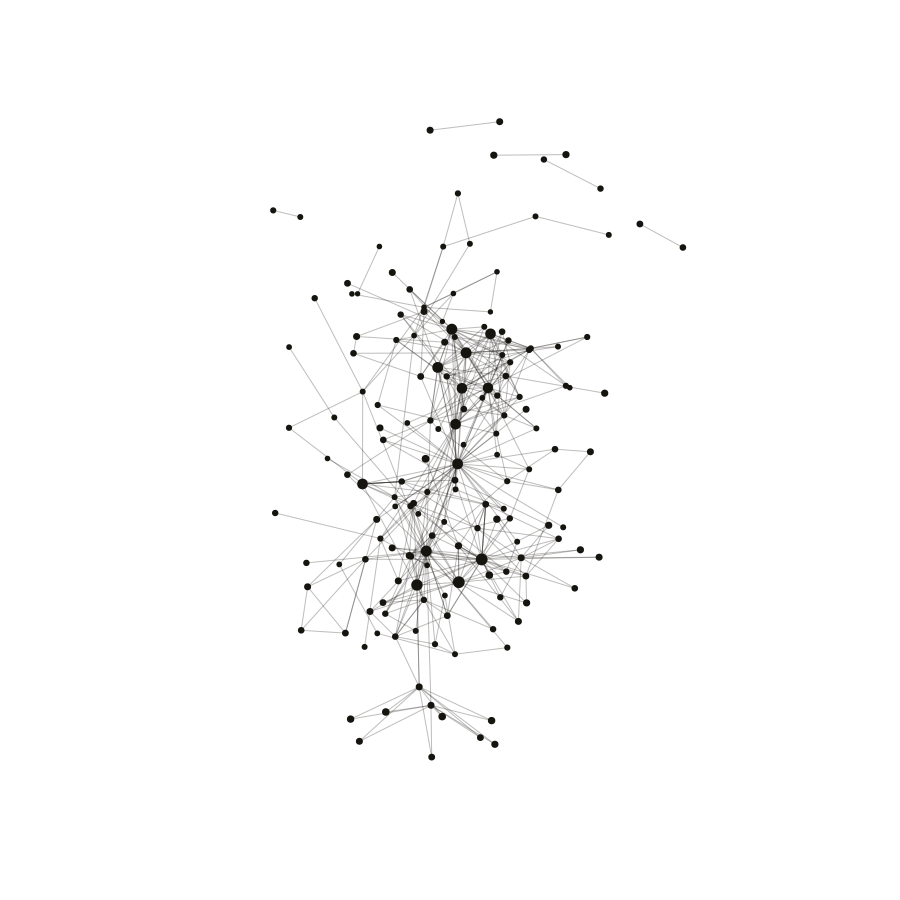
AIRview builds this from your own repo's real imports: drag a node, hover to trace what depends on what. This demo is graphed from Aletheore's own module names.
Hover a module to see what it imports.
Why it is different
Aletheore starts with deterministic repository evidence, then lets AI reason only over what the scanner can prove. The result is friendlier than raw static analysis and more trustworthy than a generic AI summary.
Docs
Every team says "we'll document it later," and later never comes: the code always outruns the wiki. Aletheore AIR writes the docs instead: grounded, per-symbol descriptions generated straight from your real source, kept current automatically, with zero engineer hours spent typing a docstring nobody wanted to write. Export the whole set as a single Markdown file whenever you need it outside the dashboard.
How Docs stays honest
Same evidence-grounded discipline as every other Aletheore surface: AI only describes what the scanner can prove exists.
Every push to an open pull request, Flash drafts a description for any public symbol that's still missing one, batched per changed file, so docs never fall behind the code.
The moment you connect a repo, AIR runs a full first pass across everything already public, so you're not starting from a blank docs page.
Every AI-touched description is grounded in the real source snippet and carries an explicit AI-generated or AI-polished marker, never silently presented as something a developer wrote.
Progress is saved symbol by symbol, so one failing file never costs the ones that already succeeded. A 48-hour sweep automatically finishes any repo with real commit activity since its last pass.
How teams use it
$ aletheore scan
Tree-sitter and git history produce air.json and air.toon. No LLM in the scan path.
$ aletheore query
Query architecture, owners, dependencies, endpoints, secrets, hotspots, and semantic search from one evidence file.
on: pull_request
The GitHub App comments on PRs, gates new secrets, and can run managed audits or Flash reviews on paid plans.
GET /health
Live endpoint checks alert on outages and latency regressions with source handler context.
Proof
Three real public repositories, actually scanned by aletheore scan at pinned commits. The numbers below are read directly from that output. Read the full writeup, findings and all →
Python, full git history
JavaScript, real npm dependencies
Go, the stress test
Real stress test
Not a curated sample: the actual torvalds/linux repository, cloned in full and scanned end to end: 94,849 files, 8.2GB, 1.46 million commits, the latest 50,000 of them analyzed. A re-scan takes 2m 29s.
Measured against Aletheore's own air.json / air.toon pair from a real self-scan (2026-09-25, o200k_base tokenizer), the exact data the MCP server and audit coding-agent adapter read.
How it measures up against a real competitor, wins and losses both: See the full benchmarks →
The deterministic local scan does not upload your code. The CLI sends a small crash report only if it crashes, and one command turns that off. Bring your own API key for AI-assisted audit reports, or skip them entirely: the evidence pipeline stands on its own.